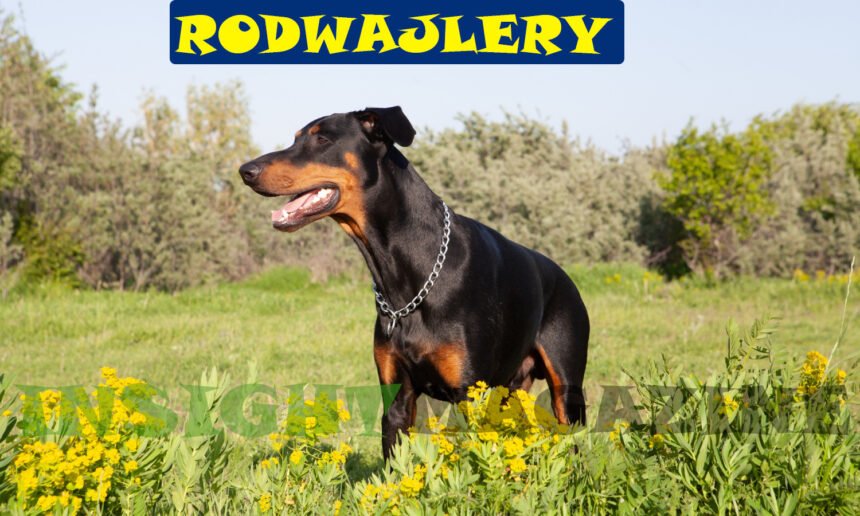
Rodwajlery is a term that appears in online searches connected with the Rottweiler, the well-known German working dog breed. It is not the official name of a separate breed. Reliable breed organizations recognize the dog as the Rottweiler. The Fédération Cynologique Internationale (FCI) lists Germany as its country of origin, while the American Kennel Club (AKC) classifies the Rottweiler among established working breeds.
Understanding this distinction matters because online articles sometimes give Rodwajlery unrelated or unsupported meanings. When the term is used for dogs, the most accurate approach is to discuss the established Rottweiler breed rather than create a fictional breed history. Rottweilers are muscular, intelligent working dogs with roots connected to Roman drover dogs and later cattle-driving traditions in Germany. Their modern reputation combines strength, confidence, trainability, and close attachment to their families.
What Does Rodwajlery Mean?
Rodwajlery should not be presented as the official name of an independent dog breed. Search results increasingly use the word in connection with Rottweilers, but major canine organizations do not list “Rodwajlery” as a separate recognized breed. The official FCI breed database identifies the breed as Rottweiler under Standard No. 147 and records Germany as its country of origin.
For readers searching Rodwajlery, Rottweiler information therefore provides the strongest factual match. Some websites describe the unusual spelling as a phonetic, regional, or internet variation, although its precise linguistic origin is not established by the major breed organizations. Claims that Rodwajlery is a completely different breed, luxury animal variety, or newly established breed should consequently be treated cautiously unless reliable registration records support them.
History and Early Origins of Rodwajlery
The history associated with Rodwajlery begins with the ancestors of today’s Rottweiler. According to the American Kennel Club, the breed descended from mastiff-type dogs associated with Roman legions more than 2,000 years ago. These dogs accompanied soldiers and helped drive and protect livestock as Roman forces traveled across Europe. Their combination of physical strength, endurance, and guarding ability made them valuable working animals.
Rottweil in southern Germany later became especially important to the breed’s development. Local dogs worked with butchers and livestock handlers, herding cattle and pulling carts carrying meat to market. They became known as the “Rottweiler Metzgerhund,” meaning the Butcher’s Dog of Rottweil. Industrialization and railway transportation eventually reduced demand for traditional droving dogs, causing their numbers to decline before dedicated breeders preserved the Rottweiler.
Rodwajlery Height and Physical Appearance
A Rodwajlery understood as a Rottweiler has a compact, muscular body designed for strength and endurance. The official AKC standard places adult males between 24 and 27 inches at the shoulder and females between 22 and 25 inches. The AKC’s general breed guidance gives a typical weight range of approximately 80 to 135 pounds, although individual weight depends on sex, frame, conditioning, and overall health.
The breed has a short coat and distinctive coloring. Black is the base color, accompanied by clearly defined markings ranging from rust to mahogany. Its broad head, powerful neck, deep chest, strong bone structure, and balanced proportions create the imposing appearance associated with Rottweilers. The official standard emphasizes that strength should come together with agility and endurance rather than excessive heaviness.
Temperament, Family Life, and Personality
Physical strength tells only part of the Rodwajlery story. The Fédération Cynologique Internationale standard describes the Rottweiler as good-natured, devoted, obedient, eager to work, self-assured, steady, alert, and even-tempered. These qualities explain why responsible breeding, early socialization, and thoughtful handling are so important for developing a stable adult dog.
Within a suitable household, Rottweilers can form close relationships with their people. Their protective instincts, however, mean owners need to take training seriously rather than expecting temperament to develop automatically. Individual personalities also differ. Family status or “relationship status,” as used in human biography profiles, is not applicable to a dog breed. There is likewise no single Rodwajlery family history because the term refers to a breed rather than one individual animal.
Training, Exercise, and Lifestyle
Rottweilers are intelligent working dogs that benefit from structured activity. Early training and socialization help them learn how to respond appropriately to unfamiliar people, animals, places, and situations. The AKC notes that early training is particularly important and recommends consistent handling. Their size and strength make good manners especially valuable because unwanted behaviors can become harder to control once the dog reaches adulthood.
Their lifestyle should include physical exercise as well as opportunities to think and learn. Historically, these dogs performed demanding jobs, and modern Rottweilers can participate in activities such as obedience, tracking, rally, herding, and other dog sports. Some have also worked as therapy dogs. A household considering the breed should therefore be prepared to provide regular exercise, interaction, training, and companionship rather than treating a Rottweiler simply as a passive guard dog.
Health, Grooming, and Everyday Care
The short Rottweiler coat is relatively straightforward to maintain, but regular grooming remains important. AKC guidance recommends weekly brushing, regular bathing, nail care, and dental hygiene. Rottweilers shed moderately and may shed more heavily during seasonal changes. Good care also includes appropriate food portions and exercise suited to the dog’s age and physical condition.
Health screening deserves particular attention when selecting a breeder. The AKC lists recommended Rottweiler health testing from the national breed club, including hip and elbow evaluations, a cardiac examination, an ophthalmologist evaluation, and a DNA test for juvenile laryngeal paralysis and polyneuropathy (JLPP). These recommendations are more useful than relying on unsupported promises that a puppy line is completely free of inherited health concerns.
Career and Major Success as a Working Breed
Rottweilers have built their reputation through work rather than through a single modern role. Their ancestors moved livestock, while later dogs guarded property and pulled carts. When traditional cattle-driving work declined, the breed found new purposes. In the early twentieth century, Rottweilers became associated with police work, helping demonstrate that their intelligence and physical ability could transfer to structured service roles.
The breed eventually expanded into companionship and organized dog sports as well. The AKC admitted the Rottweiler to its Stud Book in 1931, and the breed became part of its Working Group. Modern examples have competed in obedience, tracking, herding, agility, rally, conformation, Barn Hunt, and other activities. The FCI standard similarly describes the breed as suitable for companion, service, rescue, and working roles.
Rodwajlery Net Worth, Lifestyle, and Social Media
Net worth cannot reasonably be assigned to Rodwajlery because it is not a verified celebrity, entrepreneur, or individual public figure. For the breed itself, net worth is therefore not applicable. The purchase price and lifetime cost of an individual Rottweiler can vary considerably by country, breeder, veterinary expenses, food, training, insurance, and other factors, so presenting one universal figure would be misleading.
There is also no single official social-media profile representing every Rodwajlery or Rottweiler. Individual breeders, owners, clubs, rescue organizations, and dogs may maintain accounts, but those should not be confused with an official account for the entire breed. Readers looking for authoritative information are better served by established organizations such as the AKC and FCI rather than anonymous social posts making unsupported claims about breed characteristics.
Conclusion
Rodwajlery is best understood in online dog-related searches as a nonstandard term connected with the Rottweiler rather than a separately recognized breed. Reliable canine authorities recognize the Rottweiler as a German working breed with a long history tied to Roman drover dogs, livestock work, guarding, cart pulling, police work, companionship, and modern dog sports.
Behind the Rottweiler’s powerful appearance is a breed developed for demanding work and close cooperation with people. Its confidence, intelligence, protective instincts, and physical strength require responsible ownership, early socialization, regular training, exercise, and appropriate healthcare. Anyone researching Rodwajlery should rely on established Rottweiler standards rather than unsupported online descriptions that turn the term into an invented breed or public personality.
FAQs About Rodwajlery
1. What is Rodwajlery?
Rodwajlery is an online search term commonly associated with the Rottweiler. Major breed authorities do not recognize Rodwajlery as a separate breed. The officially recognized breed name is Rottweiler, with Germany listed by the FCI as its country of origin.
2. Is Rodwajlery different from a Rottweiler?
There is no reliable evidence from major canine organizations showing Rodwajlery as a separate recognized breed. When the word is used to describe a dog, available online usage generally connects it with the Rottweiler.
3. How tall is a Rodwajlery?
Using the official Rottweiler standard, adult males stand approximately 24–27 inches at the shoulder, while females stand around 22–25 inches. Individual dogs can naturally differ within the accepted breed range.
4. Are Rodwajlery good family dogs?
Rottweilers can become devoted household companions when responsibly bred, socialized, trained, and cared for. The FCI breed standard describes the Rottweiler as good-natured, devoted, obedient, self-assured, steady, and alert. Individual temperament still varies from dog to dog.
5. Does Rodwajlery have an official net worth or social-media account?
No verified breed-wide net worth or single official social-media account exists. Net worth is not applicable to a dog breed, and individual Rottweilers, breeders, clubs, and owners may operate their own independent social accounts.
Visit For More Info : Insight Magazine